
New York’s New Mayor Signals a Sharp Left Turn as Zohran Mamdani Begins His Term With Defiant Progressive Message
In the freezing January air of New York City, any lingering expectation that Mayor Zohran Mamdani might soften his politics or seek common ground with moderates dissolved quickly as he delivered his inaugural
1/2/20262 min read
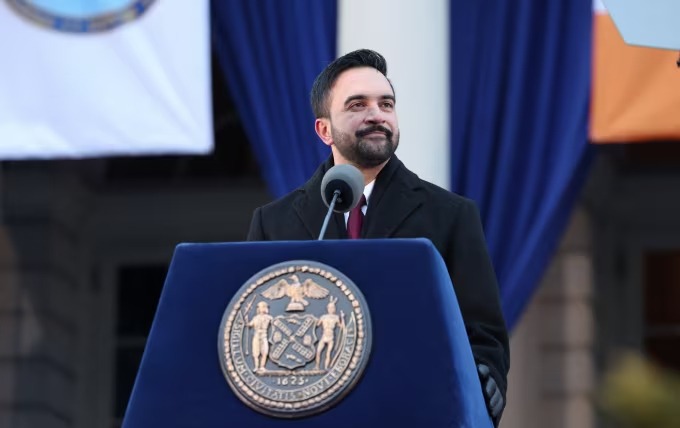
In the freezing January air of New York City, any lingering expectation that Mayor Zohran Mamdani might soften his politics or seek common ground with moderates dissolved quickly as he delivered his inaugural address, setting the tone for an administration that intends to govern firmly from the left. From the steps where he was sworn in, Mamdani made it unmistakably clear that his victory represented more than a change in leadership; it marked a political statement about the future direction of the city and, potentially, the Democratic Party nationwide.
Rather than striking a unifying or centrist note often associated with the start of a new mayoral term, Mamdani leaned into the ideology that defined his campaign. He reminded supporters and critics alike that he had been “elected as a democratic socialist” and pledged to “govern as a democratic socialist,” framing his win as a rejection of what he described as politics of complacency and an entrenched political establishment that had failed ordinary New Yorkers. The message was blunt and unapologetic, signaling that compromise with the political center would not be the guiding principle of his leadership.
Mamdani’s remarks come at a time when political polarization across the United States is deep, with cities often serving as testing grounds for bold ideological experiments. By doubling down on his progressive identity on day one, the new mayor positioned New York City as a showcase for left-wing governance, arguing that progressive liberals are not only capable of winning elections but also of effectively running complex institutions. His supporters see this moment as a long-awaited shift toward policies that prioritize housing affordability, labor rights, expanded public services, and aggressive action on inequality.
Critics, however, warn that Mamdani’s approach risks alienating moderate Democrats, independents, and business interests at a time when New York faces serious challenges, including public safety concerns, budget pressures, and economic uncertainty. Some observers had hoped the transition from campaigning to governing would bring a more pragmatic tone, but the inaugural address suggested that ideological clarity, not moderation, will define the administration’s early months.
The symbolism of Mamdani’s words matters beyond city limits. Nationally, Democrats continue to debate whether the path to future electoral success lies in centrist appeals or in energizing the party’s progressive base. Mamdani’s victory and his defiant inaugural speech are likely to be cited by progressives as evidence that voters are ready for candidates who openly challenge traditional power structures and reject incrementalism. At the same time, party strategists wary of swing voters may view his leadership as a political gamble with high stakes.
For New Yorkers, the speech served as a preview of what lies ahead: a mayor intent on reshaping city governance through a democratic socialist lens, even as he faces the practical realities of managing America’s largest city. Whether Mamdani can translate ideology into effective policy outcomes will determine not only the success of his administration but also the broader narrative about progressive governance in the United States.
As his term begins, one thing is already clear. Zohran Mamdani is not attempting to redefine himself for the comfort of skeptics. Instead, he is betting that conviction, not compromise, is what the moment demands, and that New York City can become a living example of how the left governs when it finally holds the reins of power.